It’s in my blood

In Cosworth, England the Perdues were bell founders from the late 1500s to the mid 1700s. They are my direct ancestors on my mother’s side. I was a natural at working with sculpture, especially in wax and clay in preparation for bronze. I was even told by a painting teacher that drawing was hard for me and I should stick to sculpture. It is my medium, though I do not enjoy it as much as I should. It is hard work!
I found out that I had come from a lineage of bronze casters after I earned my Bachelor of Fine Arts in bronze casting. I had chills when I found out the news. It made a lot of sense because I was able to do the work with ease.
Lost-wax casting, step by step
14 stepsThe model
A model sculpture is made out of clay or wax. It could be made out of any material because a mold will be made of the object later. People have even used found objects such as driftwood to make a bronze sculpture, because of the extreme detail that is retained in the casting process. I have seen fingerprints from the sculptor still in the bronze after finishing.

Clay up
The model is put into a clay bed and the clay-up procedure is started. The clay bed and walls are a structure that holds the mold material. This process is time consuming, and there are full-time mold makers that just create molds for foundries.

Mold material
The clay bed has key holes placed in the bottom to make sure that the mold halves fit together. Walls are built and cleaned up so the mold looks good. The clay is attached very carefully to the sculpture to avoid damaging the original. There can be no holes in the clay up because the silicone would leak out. The silicone rubber mold material is poured in this section, and a fiberglass or plaster mother mold is cast over it.

Pour spout
The first half is finished; the yellow surface is the silicone rubber. A pour spout is made out of clay so there is a hole for the wax to be poured in later. A wall is then built on the second half of the mold. Mold release is sprayed on the silicone so the two halves don’t stick together, and the process is repeated on this side: silicone first, then fiberglass or plaster.

The finished mold
The two halves of the mold, each with silicone rubber and a fiberglass mother mold, are put together and banded with rubber tubing. Wax is poured into the mold and sloshed around three or four times until the desired thickness is reached.

The wax copy
The wax copy is removed from the mold and cleaned, or chased, to remove defects and rebuild parts that did not cast correctly. This step is very important: the better the wax copy, the less finishing work is needed once it is cast in bronze.

Gating and spruing
The wax is attached to a gate and a cup that create a path for the bronze to be poured into the mold. In this case the birds are solid wax and will be cast in solid bronze. More complicated pieces get a network of gates and sprues to make sure fine detail is cast completely, since trapped air can keep parts from filling with metal.

Ceramic shell
The wax is hung upside down and a ceramic shell slurry, a liquid bonding agent with powdered silica, is painted on or the piece is dipped in a large vat. Once the first coat is dry another is applied, and for the next three coats fine sand is added to each.

Building the shell
After the first three coats with fine sand, the next four or five coats get slurry and coarse sand, until a coat of about a quarter inch covers the whole wax.
Shell wall · about ¼ inch
Burnout
The shell goes into a burnout furnace at 1650 degrees. The wax melts out and leaves a cavity where the bronze will be poured in to replace it.
Shell burnout · 1650 °F
Hot shells
The shells come out of the furnace and stay hot so they can withstand the metal being poured into them. Each is turned face up, set in a bucket, and buried in sand almost to the top to take the heat and weight of the bronze.

Casting the bronze
The bronze melts the whole time the shells are burning out. Both take about the same time, because the shells have to be hot and the metal ready at once. The bronze is poured at 2150 degrees.
Bronze pour · 2150 °F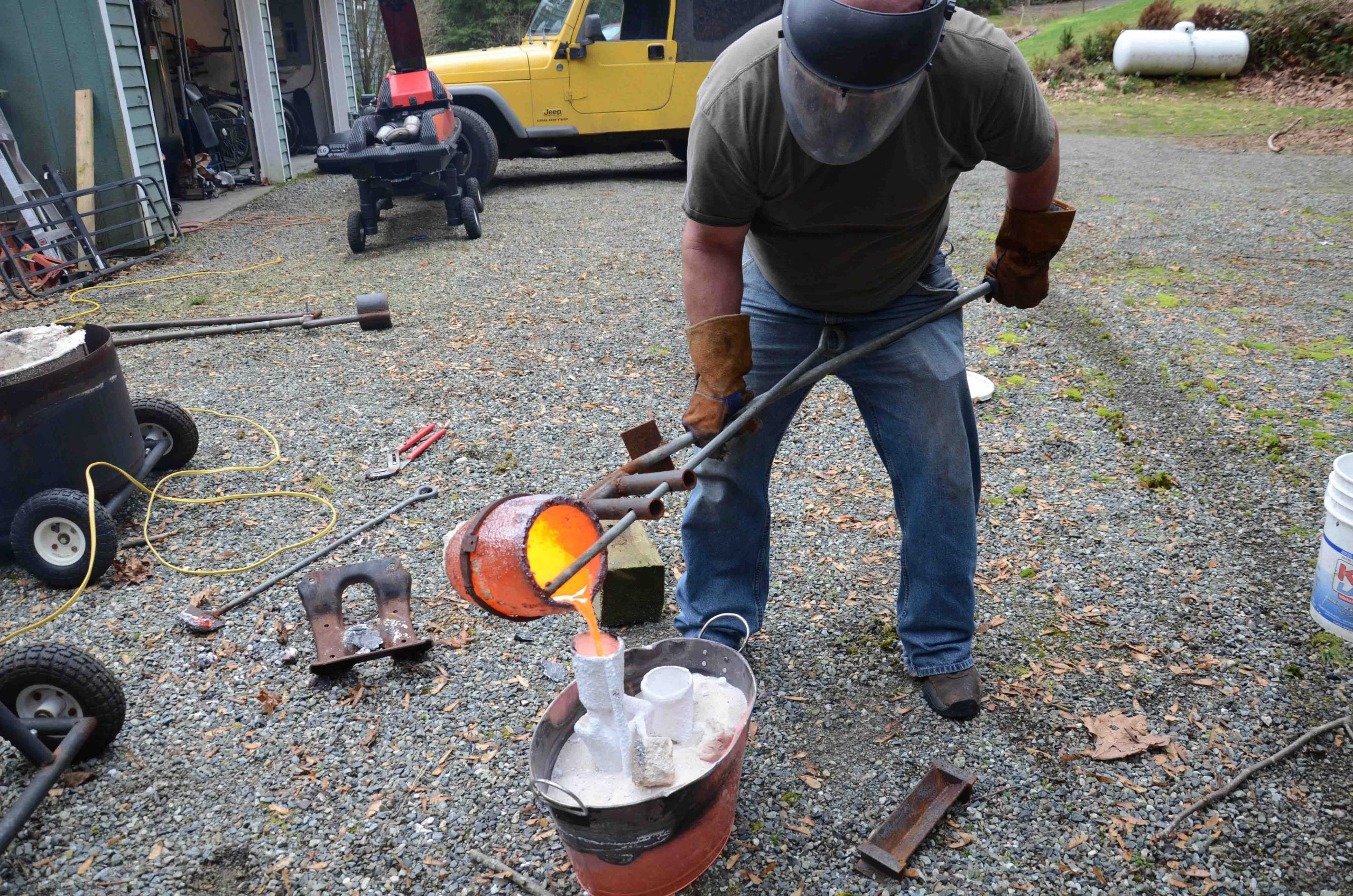
The present
This is the best part. Breaking the shell off the cast bronze is like opening a present. If everything works out you get a perfect casting of the wax copy. This is where the work really starts: the bronze is cut off the gates, welded to fix imperfections, and then chased.

Patina
After chasing comes the patina, the finish of the bronze. A chemical is applied to the surface with heat, and different chemicals make different colors. Patina is an art in itself, and some artisans do nothing else. Usually a clear coat goes over the patina to preserve the color.