Evolution of a style
How forty years of painting, sculpture and teaching design turned into Linear Abstract Expressionism.

It all started with the Orange Lady
I was in a life drawing class and we were drawing a lady that was a model there quite often. My instructor told me to do a painting of her that day instead of drawing. She told me to ignore the background and paint what I would feel went with the design of the subject in the foreground. I had studied the Abstract Expressionists and the Fauvists and had seen how they would interlace foreground and backgrounds together to make planes that contributed to an overall design. I used lines that went off of the canvas with bright or dark colors that meant nothing in reality but were purely for design.
At the same college I was told “drawing is hard for you, you should stick to sculpture.” She was right in that I was a natural at sculpture. I loved painting and I could not let it go. I knew from studying art that I did not have to be a realist to get my point across and to speak to people through my art in painting. I left drips on the canvas, made bold brush strokes and painted her completely orange with complements of blue in the horizontal planes of the background. There was a sense of freedom that I never forgot and it influenced my work from then on.

Sculpture in painting
I started to experiment with texture in my paintings by including sculpted modeling paste in the painting, actually sculpting the cliffs and the cow skull. I tried to incorporate elements of design rather than just think about reality. There are intersecting planes that represent canyon walls but are also just design features. I love color and I use bright vivid color in my works. Living in the Southwest, I grew up knowing about Georgia O’Keeffe and I loved her work. This was a piece inspired by her bone paintings.

Madonna and Child
I had been working in cast paper sculpture and this was a copy of one of the paper sculptures in an acrylic painting. I concentrated on using a simple realistic object and then adding line and horizontal planes. The thick round lines at the top of her head signify the old symbol of holiness, a halo, but stylized to add to the design of the painting.

The Regatta Series
I took the idea of a sailboat and did pure design. This is where I started to embark on only using lines, shapes, colors and planes that separated the design for the sake of only good design. I did not care about reality; I only wanted to paint my own way and what I felt was good composition. I would paint and sit back and look at the painting for long periods of time and then paint again. I would add, delete, paint over, change or rearrange.
I taught design in school every day for 20 years. I felt that I had a good grasp on what looked good. I felt really satisfied with my work and happy with the results. The best part is that it was finally fun!

The Errant Heart Series
I had been writing poetry about my life for many years. I started to create paintings to go with the poems. I would read the poem and try to create the imagery of the poem in the painting. I approached the paintings in the same way that I had in the Regatta Series. I put my emphasis on some realistic objects that would symbolize images in the poetry. The rest of the painting, and what was contained within the realistic symbols, were elements that created composition.
My intention was to create good composition and also convey the message contained in the poem to the viewer. I did not like the separation of the poetry and the paintings. I am not a poet, I am an artist, so I was hoping that I could combine them somehow.
Influences
I taught Advanced Placement Art History for a year. This was a very intensive college-level art history course given to high school students. There were artists featured that I had forgotten about who incorporated text into their paintings. I no longer had to rely on a painting and a poem separate from each other; I could write directly on the painting. I built frames and painted them in order to create a space where I could write. As I began to write with acrylic paint markers I felt a sense of freedom being able to create with the text and add images. This is how my new style was born.
Artists such as Faith Ringgold, the Dada artists, the Abstract Expressionists and Jean-Michel Basquiat. There are some Americana styles that are similar to what I am doing now with the frames. Some folk art pieces were created with writing around the frame to convey meaning relative to the content in the paintings.
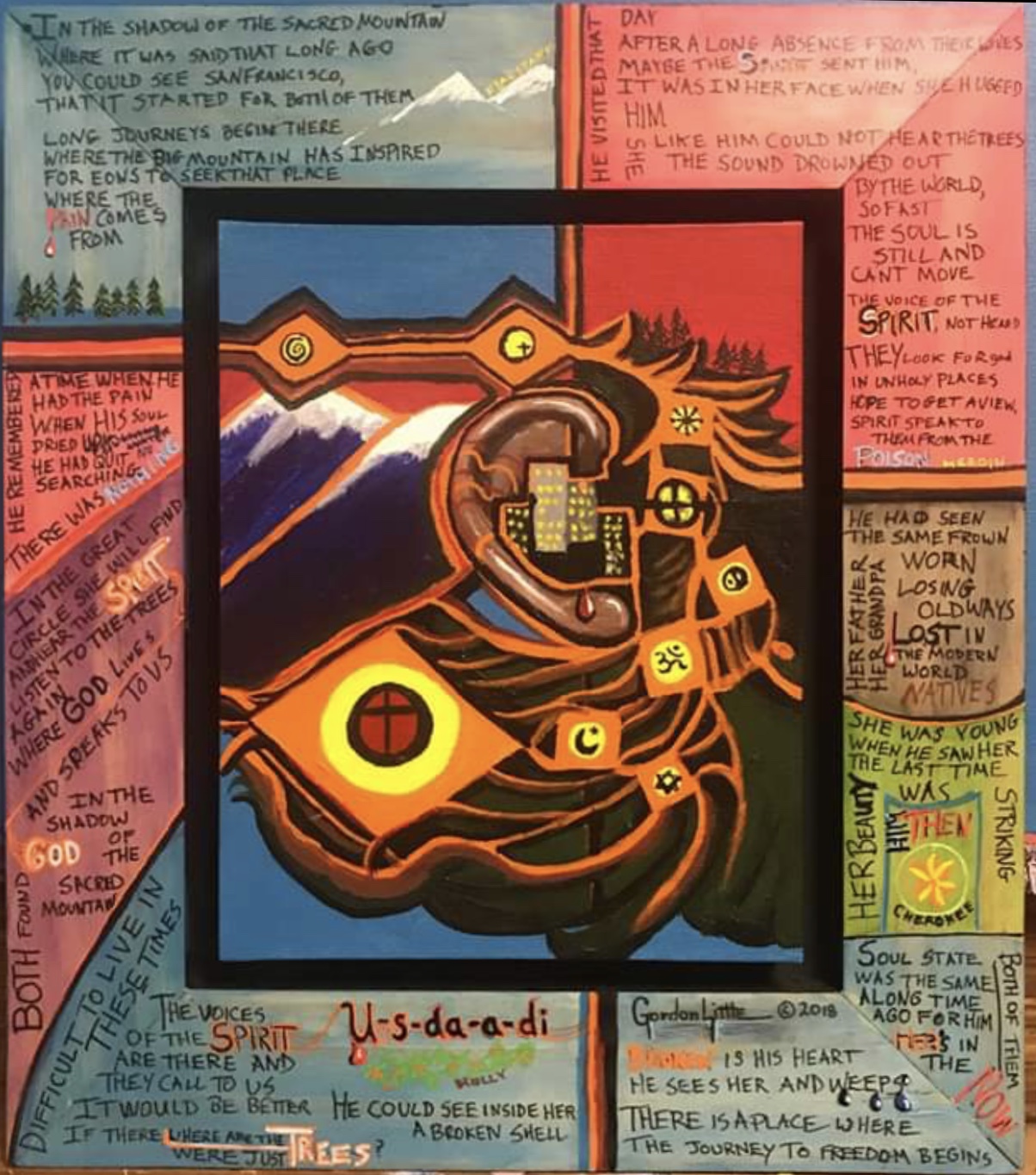
The final product
A combination of painting, wood, text and illustrations contained within the border of the painting. The painting is carried out into the frame but there is still a separation of black indentation between the canvas and the wood. Like Basquiat I can cross out words and write in any way that expresses what I feel. The words become art through the use of stylization. It is not just a poem anymore but a work as a whole that conveys meaning that goes far beyond what words alone would convey.
I use line in painting to connect the eye with different parts and to lead the viewer around the work. There is always a sense of abstraction where parts are cut up and rearranged to make a composition that goes beyond reality. I include some realistic symbolic objects to keep the viewer on point as to the subject matter that is being depicted. I like to call the style Linear Abstract Expressionism.